
The Infrastructure the Gig Economy Left Behind
Jason Jones, SaveNeighbor Founder
ECONOMY
The apps that shaped the modern gig economy didn't just create platforms for labor, they created a new layer of labor infrastructure. Millions of workers who are equipped, reachable, and accustomed to providing services independent of any particular company or industry.
Historically, most large-scale labor infrastructure was organized around employers. The gig platforms loosened that relationship–acclimating not just the workers, but the entire society to a less rigid and less conforming dimension of commerce. And triggering the development of a workforce unbeholden to scheduling, geography, language, and other criteria of typical employment.
Once that workforce came to exist at a sufficient scale, there emerged another possibility.
The platforms demonstrated that enormous amounts of labor could be organized without workers becoming permanent components of the businesses whose needs they were serving. A restaurant could gain access to delivery workers it had never hired. A household could summon transportation from someone it had never employed.
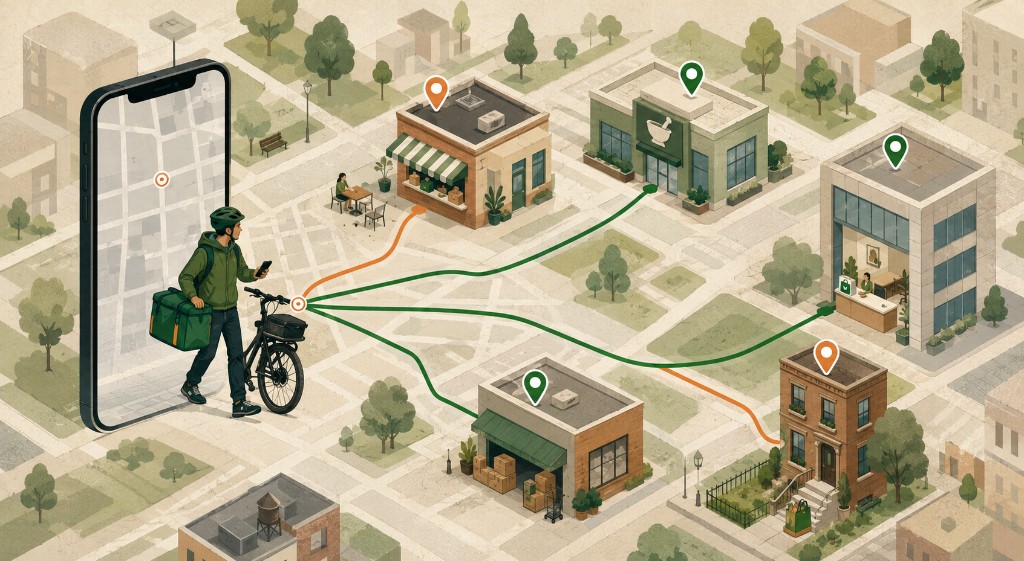
And at the heart of the transaction, the gig worker became equally as unconstrained. For example; a delivery person may already have a vehicle, smartphone, insulated bags, payment apps, and navigation experience. Crucially, none of those capabilities inherently belong to DoorDash, Uber, Grubhub, or even to food delivery as an industry. They belong to the worker.
That makes the worker potentially part of a broader local service layer. They're not a "DoorDash driver", they're a locally available person capable of performing physical-world services.
Someone who delivers Thai food Tuesday night might pick up a prescription Wednesday morning. Handle an office lunch order Thursday, help a neighborhood business move inventory Friday, and run an errand for a regular customer Saturday.
That cultural adjustment may be as consequential as the technology that enabled it.
And that's where SaveNeighbor's timing becomes interesting.
The first generation of gig platforms had to solve the chicken-and-egg problem of creating this workforce. They had to aggregate scattered workers and scattered demand. But after years of platform-mediated commerce, the underlying conditions are different. There is now a large population of people already equipped to perform distributed local services, businesses accustomed to accessing outside labor, and consumers accustomed to obtaining services from people who are not regular employees.
Today SaveNeighbor doesn't have to invent that behavior. It can simply reorganize the infrastructure that already exists around relationships instead of platforms.
The distinction — gig platforms generally don't allow the relationships between their users to become infrastructure themselves. A restaurant can interact with hundreds of drivers without developing its own delivery network. A customer can encounter an excellent driver and still receive a randomly assigned person next time.
SaveNeighbor's proposition is essentially: What if those encounters accumulated?
Then every successful transaction can potentially create something durable; a customer or restaurant connection, office relationship, neighborhood reputation, recurring route, or local network.
The gig economy created a distributed service workforce. SaveNeighbor is a coordination layer for that workforce to form persistent economic relationships with the people and businesses around them.
The irony — the platforms may have created the conditions for the services they make available to eventually become less dependent on the platforms.
Undoubtedly, SaveNeighbor couldn’t exist without the platforms having recruited the workers, normalized independent work, and retrained consumer behavior.
And without consumers eventually asking: Why are delivery fees so high?