
The Optimization Trap
Jason Jones, SaveNeighbor Founder
Tools
Every generation inherits the optimizations of the last. We’ve optimized every critical industry, from manufacturing, farming, and transportation; to communication, retail, and hiring. Each step made something faster or cheaper, easier or more scalable. Technology has created entirely new layers of economy, lifted living standards, and given ordinary people access to things that were once limited to only the wealthy.
But optimization always has a bias.
Because it asks, how can we make this repeatable or scalable? What can we remove to make this simpler? But it almost never asks; what are the benefits of being slower, or smaller, or a bit more sentimental?
That’s the trap.
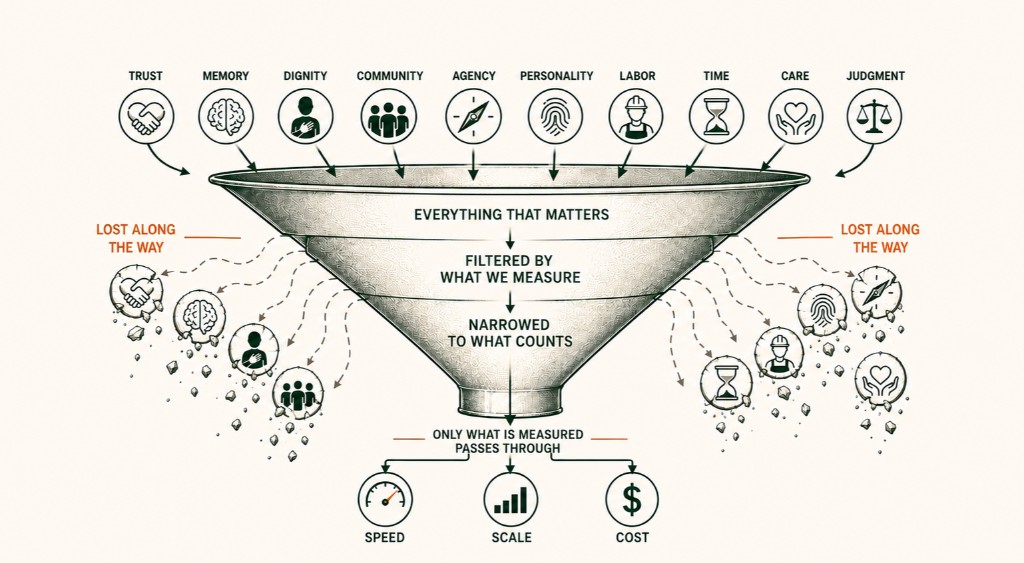
Optimization only protects what it’s told to protect, and it’s only told to protect what it can precisely measure. So what of the less measurable, the more intangible? If things like trust, memory, dignity, and community are not a part of the equation, then they quietly disappear.
Not completely, but just enough so that the forces of supply and demand turn them into modern luxuries.
AI and automation will optimize more of what remains. Work will become cheaper. Some work will be, let’s say, reorganized. Some workers will benefit in the short term. But most will spend a decade retooling while new opportunities appear.
That pattern is not new. Agricultural mechanization pushed millions out of rural work. Computers automated clerical roles. Digital platforms transformed retail, media, transportation, etc.
Work did not disappear. But opportunity moved.
And when opportunity moves, the gains rarely arrive evenly. The people closest to the old system suffer before the new one knows what to do with them. And once again we are approaching this horizon.
History says the transition will not be clean. But history also says the next generation will come with specialized tools of its own. When human effort is commoditized, and taste and trust become a marker—then the most valuable tools will be the ones built on the human platform. The ones that bridge the gaps between efficiency and humanity.
The shift has already begun, in the way we’re now finding algorithms to be offensive. How they optimize away our choice; how they presume to be better connected to who we are and what we want, than our own minds. And even if they are, optimization will never be a worthy replacement for agency or expression. It will never inspire adoption more than personality or connection.
Industry and economy will scale up, people will scale back. The world will optimize for saving time, people will optimize for spending that time with each other. The most useful tools will be created precisely at the intersection of those dynamics.