
Personal Networks Are the Future of the Service Industry
Jason Jones, SaveNeighbor Founder
Network
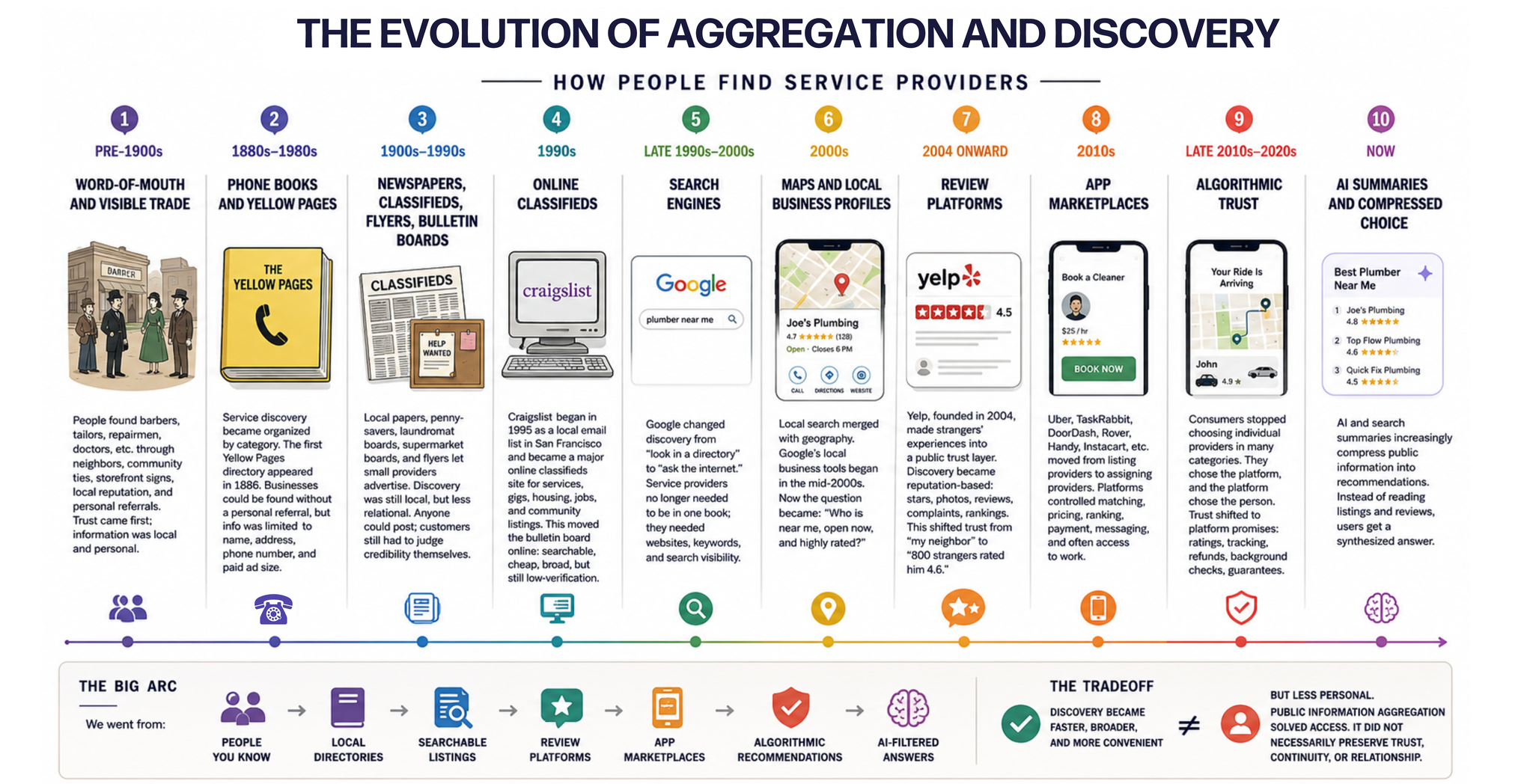
In many ways, what I think we’ll see is a reversion back to historical practice rather than the emergence of a new structure. Back to a time when people relied on the relationships that existed within a community for their basic needs and wants.
For most of human history, if you needed help, you turned to people you knew. You knew who could fix your car, or trim your hedges. You knew who to call when your family needed something, and you knew what families you could be a help to. Most work opportunities arose through relationships.
Then the shift, and corporations gradually absorbed many of the functions communities once served. Employers became sources of income and stability. People organized their lives around institutions rather than relationships, which wasn’t necessarily a bad thing. In fact, it may have been one of the greatest economic achievements in our history.
The average person no longer needed a deep network of local relationships to participate in the economy. Corporations now provided what a community once had, but for an exponentially larger group of people. The internet only further accelerated the trend, and platforms became the new intermediaries.
Need a ride? Need food? Open an app. Need someone to assemble furniture, walk a dog, deliver a package, clean a house, design a logo? Access is now instant, and relationships are optional. Is this progress?
For a while it felt like it. But now I think we’re beginning to see the limits of a world organized entirely around platforms and institutions. Even at the very basis of its value proposition, the system is barely providing the reliability we once derived from communities.
We’re seeing larger corporations, but fewer lifelong careers. Larger headcounts, but more contractors. More people assembling income from multiple sources. More people finding ways to exist outside the traditional employment structures.
Just as relationships between individuals have been diminished for the sake of scale and efficiency, we are seeing the diminishing of relationships between individuals and institutions – as the result continues to be greater scale and efficiency.
So what happens when millions of people remain economically capable but become increasingly disconnected from the institutions that organize their economic lives? The result may not be mass unemployment, it may be mass self-employment.
And if that happens, relationships begin to matter again. Again it becomes who knows you. Who trusts you. Who thinks of you when opportunities appear.
These things begin to matter more when institutions matter less. In such an environment, personal networks stop being social assets; they become economic infrastructure. A neighborhood becomes more than the place you live, and a community becomes more than a shared identity. They become sources of opportunity.
This is why I believe personal networks are the future of the service industry.
Not because platforms and marketplaces disappear. Or because people stop valuing convenience. But because familiarity and relationships become more valuable in a world where access to labor becomes more abundant.
The internet solved discovery. Artificial intelligence will eventually solve coordination. But neither will fully replace the value of being known, being remembered, and being chosen.
The future service economy may not belong exclusively to the largest platforms. It may belong to people who are able to organize opportunity within their own networks.
In that sense, personal networks are not the future at all. They are the past returning, only with better tools.